To play the classic Pressman Let’s Go Fishin’, fit one C battery, give each player a pole and switch on the rotating pond. Everyone fishes at the same time, taking one fish at a time. When the pond is empty, the biggest catch wins. The challenge is timing your pole as the fish open and close their mouths.
These Let’s Go Fishin’ instructions cover the original 21-fish game, not the XL Deep Sea edition or a different manufacturer’s fishing toy. Below you’ll find the demonstration, the supplied Pressman rules sheet and simple setup, playing and troubleshooting steps.
Bring a little spinning-pond fun to family game night. Compare the original Pressman game and plan for its separately sold C battery.
Check Let's Go Fishin' on Amazon ↗Affiliate link. As an Amazon Associate I earn from qualifying purchases. Check the classic edition, included pieces and current seller details before ordering.Watch How to Play Let’s Go Fishin’
Watch the game in action in this Triple S Games demonstration, then use the visual rules and written steps below.
Official Let’s Go Fishin’ Instructions
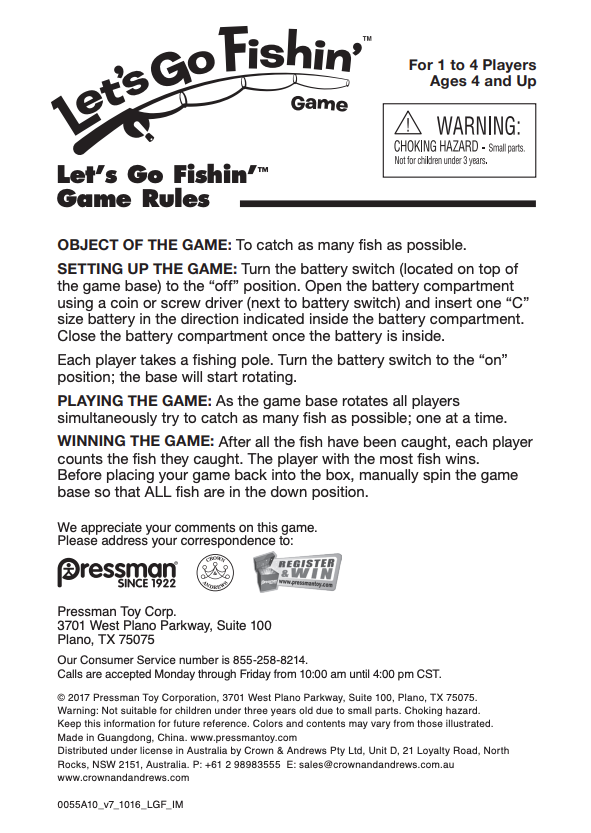
Read the sheet at its larger original size
On a phone, swipe across this enlarged view to read the print without pinch-zooming. The essential rules also appear as normal-sized text below.
Let’s Go Fishin’ at a Glance
| Manufacturer / brand | Pressman / Goliath |
|---|---|
| Recommended age | 4 years and up |
| Players | 1–4 |
| Battery | One C battery, not included |
| Contents | Game base, 21 fish, four plastic poles and instructions |
| Objective | Catch the most fish |
| Play style | Simultaneous fishing from a rotating pond |
These specifications follow Goliath’s original-game listing. Its XL Deep Sea edition instead lists 42 sea creatures, two speeds and two AA batteries. A combo package may add a separate Go Fish card game. Do not transfer those extras or battery specifications to the standard game.
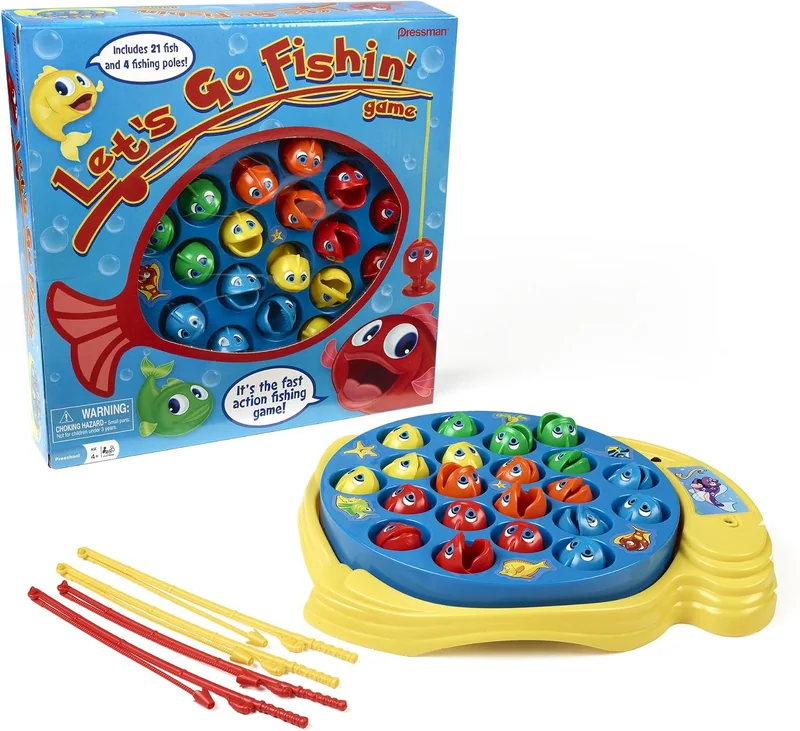
How to Set Up Let’s Go Fishin’
Have an adult install the battery. Use the markings on your actual game if its compartment differs from the pictured edition.
- Switch OFF. The supplied sheet locates the switch on top of the base, beside the battery compartment.
- Open the battery cover. The sheet specifies a coin or screwdriver. Use the tool that fits the fastening on your unit.
- Insert one C battery. Match its positive and negative ends to the compartment markings; do not guess from the game’s orientation.
- Close the compartment. Secure the cover before handing the game to a child.
- Prepare the pond. Put the fish into their individual spaces. Count the pieces so you know whether the full 21-fish set is present.
- Give each player one pole. Keep the unused poles aside if fewer than four people are playing.
- Switch ON. The base should rotate. If it stays still, switch off and follow the checks below before starting.
As a practical setup suggestion, use a stable, dry tabletop with space for everyone’s catch. Keep packaging and spare pieces out of the fishing area so children can concentrate on the moving fish.
How to Play Let’s Go Fishin’
There are no alternating turns in the standard rules. Everyone tries to catch fish simultaneously. Explain that before switching on, especially if the children are used to waiting for a dice roll.
- Watch a fish. Follow its position as the pond rotates and its mouth opens and closes.
- Try to catch it with your pole. As a playing suggestion, aim the pole’s end toward an open mouth and lift gently when it catches. A missed attempt is part of the timing challenge.
- Take one fish at a time. The official rules specify individual catches rather than scooping up several pieces together.
- Keep your catch separate. Put caught fish beside your own place so counting is straightforward.
- Continue until every fish has been caught. Then stop and compare the catches.
You do not need to announce a fish colour, roll a die or draw cards for this standard round. Any separate card game in a combo package has its own rules. Keep that activity separate from fishing in the rotating pond.
How Do You Win?
Each player counts the fish they caught. Whoever has the greatest number wins. The supplied sheet gives no different points for different colours, so count fish rather than assigning colour values.
A useful counting check is that everyone’s piles should total 21 when the complete set was used. If the total is short, look for a remaining fish in the pond or a piece that fell nearby before declaring one missing.
The sheet does not specify a tie-break. Sharing the win or playing another round are reasonable house rules; agree on the choice together. A timed practice round or a shared family target is also an optional variation, not the printed competition.
Tips for Catching More Fish
These are practical suggestions, not manufacturer-guaranteed techniques:
- Watch one target first. Following a single mouth can be easier than chasing whichever fish looks closest.
- Use small movements. Move the pole gently rather than pushing against the fish or pulling hard when a catch fails.
- Leave space for other poles. If two players reach for the same fish, backing away and choosing another can prevent a tangle.
- Practise before scoring. A short unscored attempt lets a younger player explore the timing without losing a competitive round.
If someone is frustrated, pause and demonstrate one gentle attempt. The aim is to learn the moving target, not to make the mouth stay open by force.
Let’s Go Fishin’ Not Spinning?
Start with the power setup confirmed by the rules. The later positioning checks are basic, non-invasive suggestions; they are not a diagnosis of the motor.
| What you notice | What to check |
|---|---|
| No rotation after setup | Switch OFF, confirm one C battery is installed in the marked direction, close the cover, then switch ON. |
| Still no movement | Try a fresh battery of the specified size. Do not substitute a smaller cell with homemade spacers. |
| A pole or loose object is in the moving area | Switch OFF before removing the loose item. Keep hands and tools away from a moving mechanism. |
| Rotation stops again or parts appear damaged | Stop play and contact Goliath with the model details. Do not dismantle the motor housing. |
Do not hold the switch halfway between settings or repeatedly force the pond around to make it start. If the battery compartment is damaged or has leakage, keep the game with an adult and ask support for advice rather than letting children continue playing.
Fish Not Opening or Closing?
First distinguish a stationary pond from an individual fish problem. If the whole base is not rotating, use the power checks above. If it rotates but one fish behaves differently, switch off before examining the visible piece.
Check that the fish is sitting normally in its own space and that a loose pole is not holding it. Remove only an easily accessible loose obstruction. If a piece will not settle naturally, stop rather than pressing it down or prying its mouth open.
The supplied sheet does not provide an internal repair procedure. Avoid adding oil, glue or replacement magnets, and do not bend mechanisms to imitate an online fix. Photograph the affected fish and explain whether the pond still rotates when contacting support.
Fishing Rod Not Catching Fish?
A working pond does not guarantee an immediate catch. Try the normal timing challenge again, watching an open mouth and using a gentle lift. If a child is lowering the pole only after the mouth has closed, a missed fish is not enough to establish a fault.
With the game switched off, an adult can visually compare the pole with another supplied pole for an obvious missing or broken end. Put damaged pieces aside. Do not sharpen a pole, add a metal hook or substitute real fishing tackle.
Ready for another family fishing round? Take a look at the original Pressman game and choose the offer that fits your plans.
Shop Let's Go Fishin' on Amazon ↗Affiliate link. As an Amazon Associate I earn from qualifying purchases. Check the classic edition, included pieces and current seller details before ordering.How to Reset and Store the Game
For another round, switch off, return the fish to their individual spaces and give everyone back a pole. Switching on starts the next round; the printed rules do not describe a score memory or electronic factory reset.
Before boxing it up, the supplied Pressman sheet says to manually turn the game base until all fish are in the down position. Do this with the power off and without force. This storage instruction is separate from troubleshooting a jammed mechanism.
Store the fish and poles together. Counting them before putting the lid on is a simple way to notice a lost piece while everyone still remembers where they played.
Frequently Asked Questions
How many batteries does Let’s Go Fishin’ need, and what size?
The classic version covered here uses one C battery, sold separately. Check the actual compartment for another edition; XL Deep Sea uses two AA batteries.
Can one person play?
Yes: the original is listed for one to four players. Solo play lets someone practise clearing the pond. A personal timer or target is an optional challenge rather than an official scoring rule.
What age is it for?
Ages four and up. The sheet also carries a small-parts choking warning for children under three; that warning does not change the recommended starting age to three.
Do players take turns?
No. Standard play is simultaneous, one fish at a time per player. Count the catches when the pond is empty.
Can you play without batteries?
The battery powers the rotating pond used in the printed game. Handling the pieces without power is not the standard moving-pond experience; do not manually drive it as a substitute during play.
Are replacement poles or fish available?
Ask Goliath Support about options for your exact model. We have not confirmed a currently orderable official spare-parts pack. Include the model number and photographs; pieces advertised for older or XL games should not be assumed compatible.
Ready for the Next Round?
The useful sequence is simple: check the power setup, watch the moving mouths, catch individually and count together. For buying, use the two Amazon options in this guide and check the exact edition and included pieces. This is a researched guide, not a hands-on product test.
Want fish-themed play built around digital pet care instead? Our Bitzee Aquarium instructions cover that separate toy. Find more formats in Trending Finds.
Sources and Model Notes
Checked October 30, 2026. The supplied 2017 Pressman sheet provides the operating rules and storage direction. Goliath’s original-game page corroborates the standard specifications; its XL page and combo page explain edition differences. Use current manufacturer support rather than relying on old contact details printed on a historical sheet.